Loading
August 14, 2026
The Invisible Work of Being a Stepmom, And Why It Is Burning You Out
The Work Nobody Sees: Understanding Stepmom Burnout Stepmom burnout isn’t about failing—it’s about doing a job nobody sees, in a role nobody fully respects. Discover the hidden cost of invisible emotional labor and learn how to navigate the blended family dynamic without losing yourself.
If you are a stepmom who is exhausted in a way you cannot fully explain, this post puts words to exactly what you have been carrying. Because stepmom burnout is not about being weak, it is about doing a job that nobody sees, in a role that nobody fully respects, with emotional labor that nobody counts. And it is time someone said that out loud.
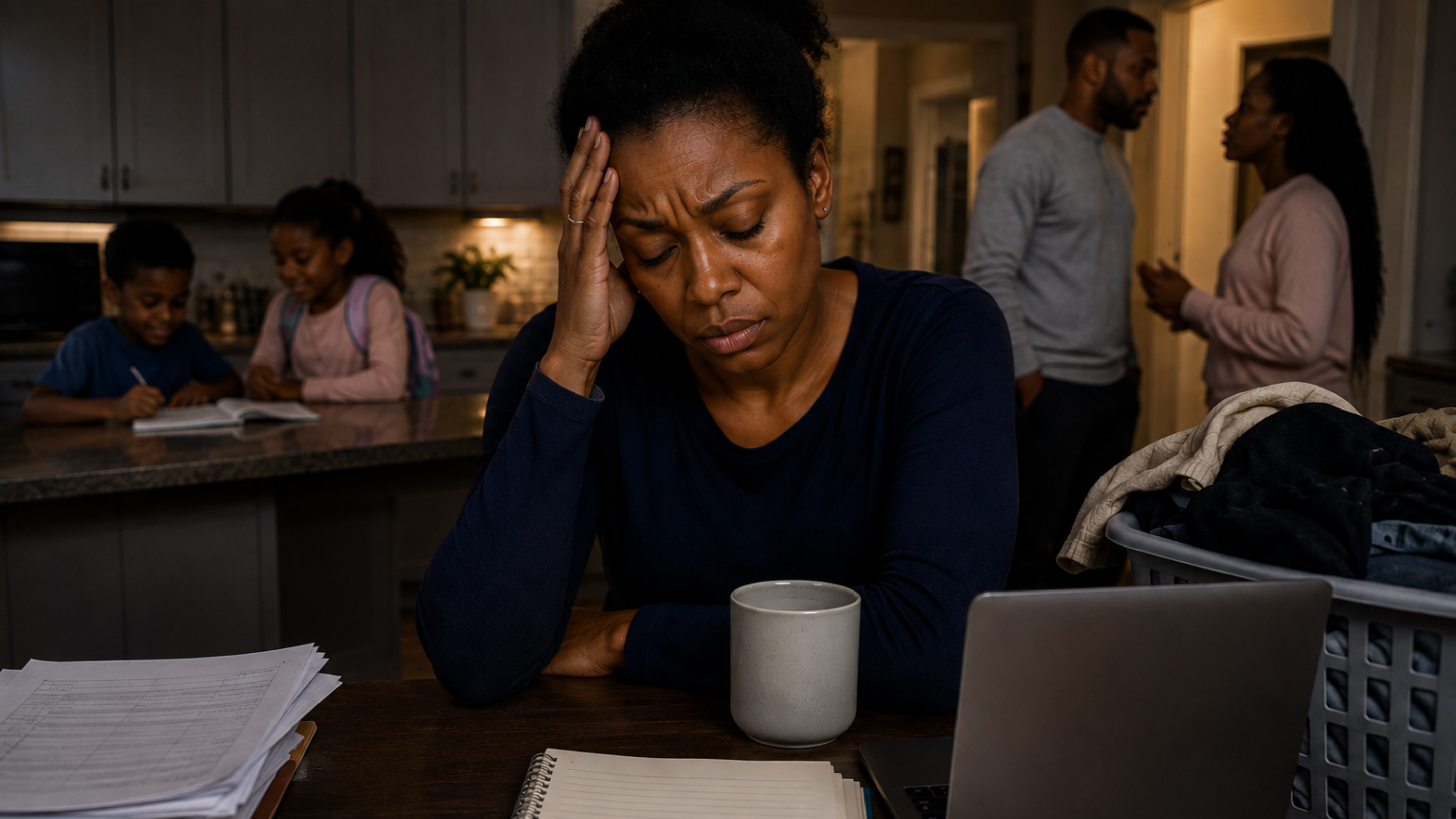
Nobody told her what she was signing up for. She walked into her blended family with her eyes open, or so she thought. She knew it would take adjustment. She expected challenges, and she was ready to work for it.
What she was not ready for was the specific kind of exhaustion that would follow her everywhere. The kind that lived not in her body but somewhere deeper. The kind that survived good days and quiet weekends and occasional moments of genuine family warmth. The kind that was still there, heavy and nameless, when everything around her looked perfectly fine.
She sat with me one afternoon and said something I have not stopped thinking about since.
"I feel like I am doing a full-time job that nobody knows exists. And the worst part is that if I ever say that out loud, I sound like I am complaining about my own family."
She is not complaining. She is describing something real. And it has a name.
The Work Nobody SeesEmotional labor is not a new concept. But most conversations about it miss the specific, compounded weight of what stepmothers carry.
Emotional labor refers to managing and regulating one's emotions to meet the expectations of others, often in the context of caregiving or social interactions. It includes maintaining harmony in relationships, soothing emotional turmoil, and anticipating others' needs. While emotional labor can benefit families and communities, it is often underappreciated or entirely unrecognized, especially when it falls on women whose caregiving is seen as simply what they naturally do.
For stepmothers, this plays out at a level that is categorically different from almost any other domestic role. She manages her own emotions, the grief over not being fully accepted, the frustration she suppresses in public, and the loneliness she cannot explain without sounding ungrateful. She manages the children's emotions, navigating loyalty conflicts, processing their resistance, and holding space for their grief over a family structure that changed before she arrived. She manages her partner's emotions, absorbing his guilt, smoothing his tension, and carrying his exhaustion alongside her own. She manages the co-parenting dynamics, holding her tongue, adjusting her expectations, and disappearing when the other household needs to take precedence.
And she does most of it invisibly without acknowledgment, and often without even a name for what she is doing.
Research published in the Journal of Family Issues in 2025 found that mothers perform 71 percent of cognitive labor in heterosexual households, even when both partners work full time. A 2025 analysis across 42 countries found that women spend an average of 4.2 hours per day on unpaid care and domestic work, compared to 1.7 hours for men. The gap narrows in households with more equitable divisions of visible tasks, but the invisible work- the remembering and coordinating and emotional monitoring- remains stubbornly skewed.
Now add the specific complexity of a blended family onto that foundation. The loyalty minefields. The co-parenting calendar. The children who may love her on Tuesday and shut her out on Thursday. The constant recalibration of where she belongs and how much of herself she is allowed to take up. The invisible labor of a stepmom is not a variation on the invisible labor of motherhood. It is an entirely different terrain.
Why Nobody Sees It, And Why That Makes It So Much WorseHere is what makes stepmom burnout uniquely painful. It is not just that the work is hard. It is that the work is invisible, and then she is held responsible for the outcomes of work nobody acknowledged she was doing.
While much of the conversation around blended family mental health focuses on children or biological parents, stepparents face a unique psychological burden that can lead to identity erosion, chronic stress, and complete burnout. Stepmothers are expected to show up with a smile every single day, meld effortlessly, and never have a negative feeling about it, while simultaneously being held entirely responsible for the success or failure of the family dynamic. They are not supposed to need any help at all. And yet nobody extends them the same grace that every other parent in that family receives.
She gives constantly to the children who may not reciprocate. To a partner who is doing his best but often cannot see what she is carrying. To a family system that has its own history, its own loyalties, its own unspoken hierarchy, and she is trying to find her place in it while simultaneously holding the whole thing together.
Research shows that women who bear disproportionate responsibility for invisible household and emotional labor report significantly lower life satisfaction, higher rates of feeling empty, and greater role overload, regardless of how well the visible dimensions of their lives appear to be functioning.
She usually looks fine externally. Her home looks functional. The children are fed, scheduled, and shown up for. And underneath all of it, she is running on empty in a way that nobody around her has thought to ask about.
What Burnout Actually Looks Like for StepmomsStepmom burnout does not always announce itself dramatically. More often, it arrives quietly, in the gradual dimming of the woman who existed before the blended family began.
She stops initiating things she used to love. She notices she has opinions about the family dynamic that she stopped voicing months ago because the effort of defending them was too great. She performs warmth without feeling it. She goes through the motions of connection while something inside her has quietly gone numb. She might not even call it burnout. She might call it exhaustion, or feeling stuck.
A sense of identity loss, feeling like you have become a logistics system rather than a person, is one of the strongest predictors of severe burnout in women carrying disproportionate invisible labor. The work does not just drain energy. Over time, it erodes the self.
That erosion is real. And it is not fixed by a weekend away or a conversation about task distribution. It requires something deeper, the kind of support that actually speaks to the specific, layered experience of being a stepmom in a world that does not fully understand what that means.
You Deserve More Than Just Surviving ThisI want to say something to you directly before we close.
What you are carrying is not a sign that you are failing at this role. It is a sign that you have been doing an extraordinary amount of work, in an extraordinarily complex environment, with an extraordinary amount of grace, and very little of it has been seen or named.
Your exhaustion is not weakness. It is the accurate report of a woman who has been giving enormously, without the resources, the recognition, or the support that any person doing this much work deserves.
You do not have to keep surviving this alone. And you do not have to wait until you have nothing left before you choose yourself.
There is support that was built specifically for the place you are standing in right now.
Two Resources Built for YouThe first is the Step Out Stepmom book and Dear Stepmom Workbook Bundle, two resources I created from my lived experience of blended family dynamics.
The Step Out Stepmom book speaks to the specific emotional terrain of stepparenting: the loneliness, the invisible labor, the identity questions, and the path toward navigating this role with wholeness rather than depletion. The Dear Stepmom workbook walks you through the inner work practically, one page at a time, at your own pace and in your own space.
Together they are the starting point I would put in the hands of every stepmom who is tired of feeling unseen in her own life.
Get your bundle here.
The second is a private session with me directly. If what you are carrying feels bigger than a book can handle right now, if there are layers of accumulated pain, identity loss, or emotional exhaustion that need a real, safe, professional space to process, I would love to work with you one-on-one.
You deserve to be heard, fully and without editing yourself.
Book your private session here.
The invisible work you have been doing deserves to be seen. Starting with being seen by yourself.
Adeola Kingsley James is a Certified Rapid Transformational Therapist, Clinical Hypnotherapist, Stepmom Coach, Best-Selling Author, and founder of OMG Global, Owning My Greatness. She walked this road herself. She knows what it costs. And she has spent years creating the support she wished she had when she needed it most. If this post named something you have been carrying quietly, you are welcome to reach out.
References
Alpha Mothers. (2025, June). *Invisible labor in motherhood: The hidden work no one sees.* https://alphamothers.com/resources/invisible-labor-motherhood-hidden-work
Better Life Lab at New America. (2025). *Women and unpaid domestic work: A 37% gap that persists across employment status.* Cited in Charlottesville Family Magazine, January 2026.
Charlottesville Family Magazine. (2026, January 6). *The hidden work: Understanding the invisible labor of motherhood.* https://charlottesvillefamily.com/invisible-labor-of-motherhood/
Dowa Health. (2025, August 28). *The invisibility of emotional labor: Making the hidden work visible.* https://www.dowahealth.com/blogs/the-invisibility-of-emotional-labor-making-the-hidden-work-visible
Journal of Family Issues. (2025). Cognitive labor in heterosexual households: A 2025 systematic review. *(As cited in Alpha Mothers, 2025.)*
PMC / National Library of Medicine. (2021). *Invisible household labor and ramifications for adjustment: Mothers as captains of households.* https://pmc.ncbi.nlm.nih.gov/articles/PMC8223758/
ReachLink. (2026, May 4). *Blended family mental health: 5 struggles parents miss.* https://www.reachlink.com/advice/family/blended-family-mental-health-5-struggles-parents-miss/
Shapiro, D. N., & Stewart, A. J. (2011). Parenting stress, perceived child regard, and depressive symptoms among stepmothers and biological mothers. *Family Relations, 60*(5), 533–544.