Loading
November 5, 2026
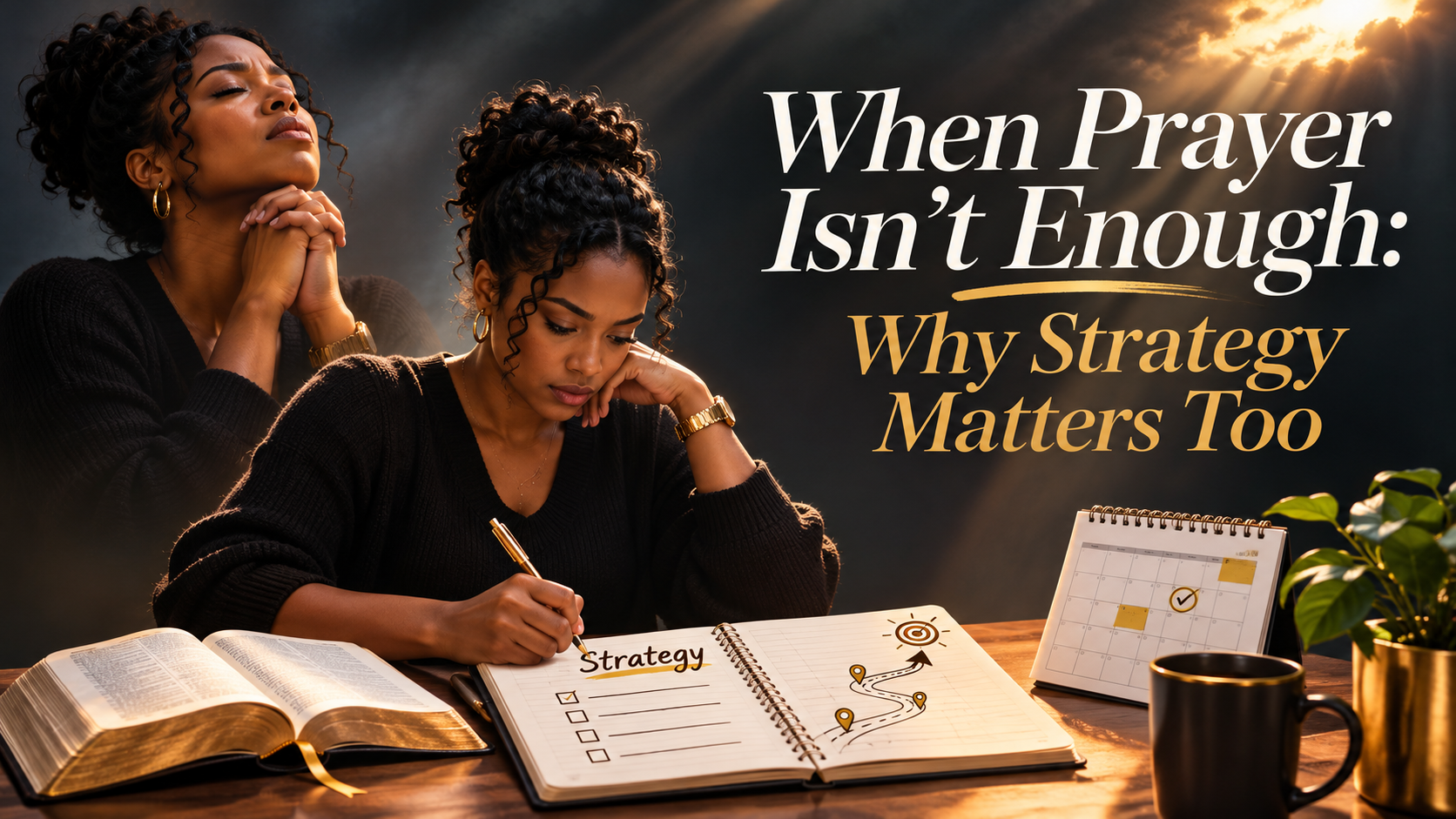
When Prayer Isn't Enough: Why Strategy Matters Too
You've prayed about it for years. You've fasted, declared and believed. So why does it feel like nothing is changing? This isn't a post against prayer. It's a post about the partner prayer was always meant to have.
If you have been praying about the same thing for years and quietly wondering whether something is wrong with your faith, this post is for you. Because nothing may be wrong with your faith at all. You may simply have been asked to carry with prayer alone what God designed to be carried with prayer and a plan.
Let me say this clearly before we go any further. I am a woman of faith. I pray. I believe in the power of prayer with my whole heart. This is not a post against prayer.
It is a post for the woman who has been praying faithfully, and suffering silently, because somewhere along the way she learned that asking for any other kind of help meant she didn't trust God enough.
Chioma was that woman.
For four years, she had been having what she called "attacks." Her heart would pound, her chest would tighten, and she would feel sure she was about to die. It happened in traffic, in meetings, once in the middle of a church service.
She prayed. She fasted. She went for deliverance. She stood on every scripture she knew. Her prayer partners covered her. And still the attacks came.
"My pastor told me I needed to pray more," she told me quietly in our first session. "So I did. I prayed harder. And when it didn't stop, I started to believe God was angry with me. Or that my faith was too weak." She looked down. "I almost didn't come here. I thought seeing a therapist meant I'd given up on God."
What Chioma had been experiencing were panic attacks. They are real, they are common, and they are very treatable. She had been carrying something with one hand that was meant to be carried with two.
Nehemiah Prayed, and Posted GuardsOne of my favourite stories in the Bible is Nehemiah rebuilding the walls of Jerusalem.
He was a man of deep prayer. The book opens with him weeping, fasting and praying for days. When he stood before the king, he prayed silently before he answered. His whole mission was soaked in prayer.
But when enemies threatened to attack the builders, look at what Nehemiah did:
"Nevertheless we made our prayer unto our God, and set a watch against them day and night, because of them." — Nehemiah 4:9 (KJV)
They prayed. And they posted guards.
Nehemiah didn't see a contradiction between trusting God and taking practical action. He armed the builders. He organised shifts. He made a plan. And the wall was finished in fifty-two days.
That is the model I want to offer you today. Not prayer instead of strategy. Not strategy instead of prayer. Prayer and strategy, working together.
Scripture Is Full of StrategyOnce you start looking, you see it everywhere.
Joseph interpreted Pharaoh's dream through divine revelation, then designed a seven-year food storage plan that saved nations. Jesus told us to count the cost before building a tower (Luke 14:28). James wrote that faith without works is dead (James 2:17). Paul, a man who saw miracles, still advised Timothy to take a little wine for his stomach's sake (1 Timothy 5:23). Practical care alongside faith.
The Good Samaritan didn't just pray over the wounded man. He bandaged his wounds, poured in oil and wine, took him to an inn and paid for his care (Luke 10:34–35).
God is not threatened by doctors, therapists, plans or tools. Very often, He uses them.
What the Research Says About Faith and CopingPsychologist Kenneth Pargament has spent decades studying how faith helps people cope with hard things. In an influential 1988 study, he and his colleagues described three different ways that religious people tend to approach problems.
In the self-directing style, people rely mainly on themselves and leave God out of the practical picture. In the deferring style, people hand everything to God and wait for Him to act, taking little action themselves. And in the collaborative style, people see themselves as working together with God: praying and acting, trusting and taking responsibility.
The researchers found that the collaborative style was linked with better outcomes, including a stronger sense of personal competence. The deferring style, where people waited passively, was linked with a weaker sense of being able to handle life.
In other words, faith works best not when we sit back and wait, but when we partner with God in the work.
Psychologists also talk about something called spiritual bypassing, a term coined by psychotherapist John Welwood. It describes using spiritual ideas and practices to avoid dealing with painful emotions or unresolved wounds. It sounds like: "I'm covered, so I don't need to talk about it." "I've forgiven, so I shouldn't still feel angry." "If I had real faith, I wouldn't be anxious."
Spiritual bypassing isn't real faith. It's avoidance wearing church clothes. And it keeps so many beautiful, devoted women stuck in pain that could have been healed.
Why This Is So Hard for Women of FaithMany of us were raised in communities where every problem had a spiritual answer, and seeking any other kind of help was seen as a lack of faith. Anxiety meant you weren't trusting God. Depression meant you weren't grateful enough. Marriage troubles meant you needed to submit more and pray harder.
Those messages usually came from love. From people who genuinely believed prayer was the answer to everything. But they left many women feeling like failures. Praying harder, suffering longer, and quietly concluding that God must be disappointed in them.
Here is what I want you to know. The World Health Organization is clear that depression is a real health condition with effective treatments, and that talking therapies are the first line of treatment. The same is true of anxiety and panic. Seeking treatment for them is no more a lack of faith than taking medicine for malaria or wearing glasses to read your Bible.
You can pray for healing and go to the doctor. You can trust God with your marriage and see a counsellor. You can declare His promises over your mind and work with a therapist to heal your trauma. These are not rivals. They are partners.
What a Prayer-and-Strategy Life Looks LikeThis is the approach I teach through The Lifegiver Method™, which honours the spiritual dimension of healing alongside the psychological, emotional and physical.
Pray about it, then ask, "What's my part?" After you pray, pause and ask God, and yourself, what practical step is yours to take. A conversation. A boundary. A budget. A booking.
Name the problem accurately. Chioma had been fighting "attacks" for four years. The moment she understood they were panic attacks, she could finally get the right help. Naming something clearly is not unspiritual. It's wisdom.
Let help be part of the answer. Sometimes the answer to your prayer comes in the form of a person. A doctor. A counsellor. A friend who finally asks the right question. Don't reject the answer because it didn't arrive the way you expected.
Deal with the root, not just the fruit. Many recurring struggles, in relationships, finances or emotions, are rooted in old wounds and beliefs. Prayer gives you strength and grace. Healing work helps you find and address what's underneath.
Keep praying through the process. Strategy doesn't replace prayer. It walks alongside it. Pray over your therapy sessions. Pray over your plans. Invite God into every step.
What Changed for ChiomaChioma kept praying. She never stopped. But she also started working with me. We addressed her panic from several angles: understanding what was happening in her body, learning tools to calm her nervous system, and going back through Rapid Transformational Therapy to the old experiences that had taught her body to live on high alert.
Within a few months, the panic attacks had become rare. Then they stopped.
"I used to think coming here meant I'd given up on God," she said in one of our last sessions. "Now I think this was God. He answered my prayer. I just didn't expect Him to answer it through a therapy room."
A Reflection for TodayThink of one thing you've been praying about for a long time. Then ask yourself gently: Have I been waiting for God to do my part as well as His? And: What is one practical step I could take this week, as an act of faith, not a replacement for it?
Write it down. Pray over it. Then take the step.
Your Next StepIf you've been carrying something alone for a long time, and you're ready to add a practical step to your prayers, it can start with one honest conversation.
"I Need To Talk" with Adeola is a private, one-on-one session where you can bring whatever you've been carrying, faith included. You don't have to leave your beliefs at the door. We'll talk honestly, find out what's really going on, and work out the right next step together.
Book your "I Need To Talk" session here
And if you're ready for deeper work on the root causes, book a private consultation with me here. We'll explore how Rapid Transformational Therapy and The Lifegiver Method™ can help you heal, alongside your faith, not in place of it.
Keep praying, my love. And then set your watch.