Loading
August 14, 2026
Why You Can Share a Bed with Someone and Still Feel Completely Alone
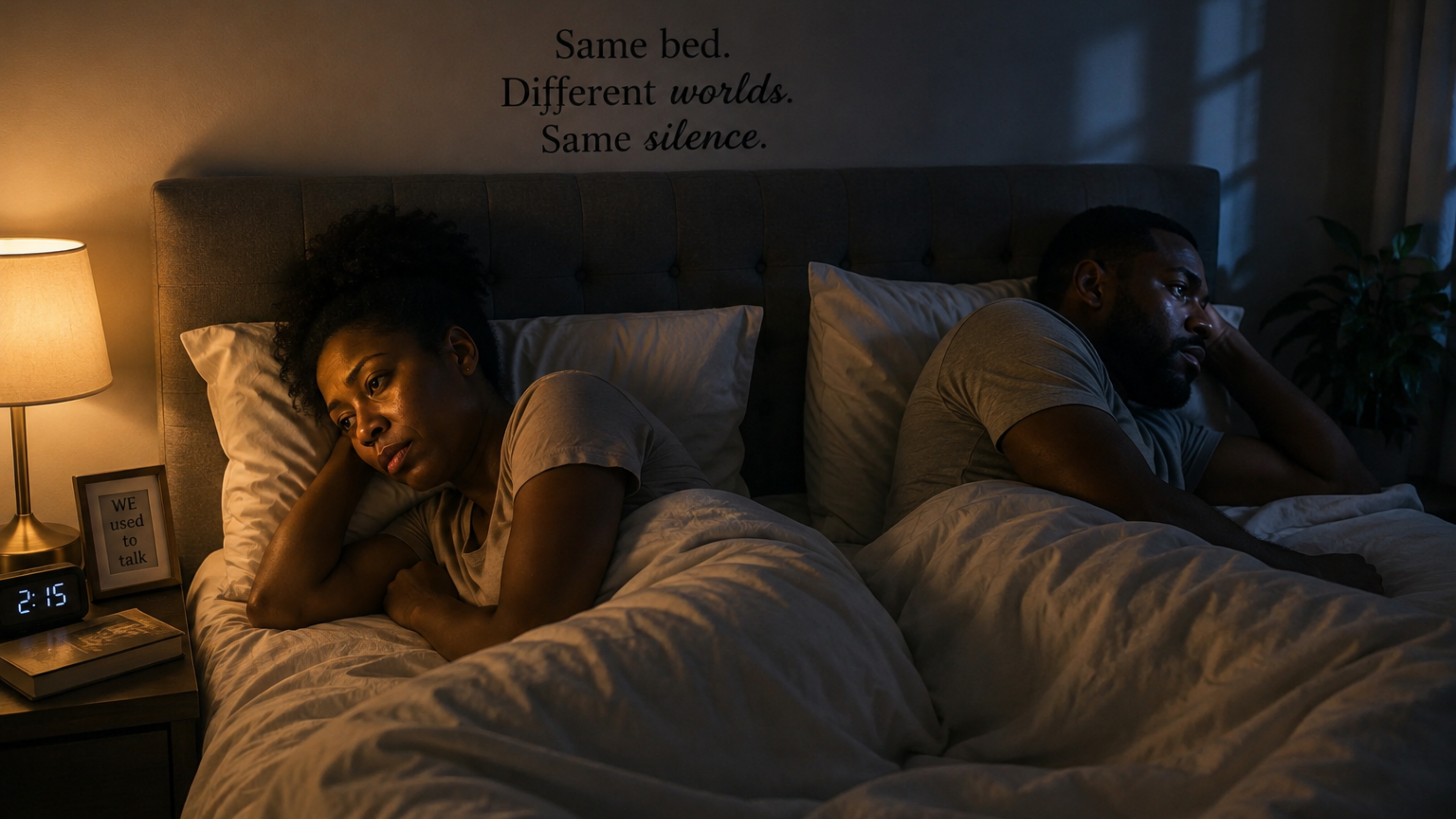
Are you living with your partner, or just living beside them? You share a bed, split the bills, and your life looks full from the outside—yet you feel completely, inexplicably alone. Discover why nearly half of married women experience this silent disconnection and how reclaiming your authentic voice is the key to truly being found in your marriage.
How do you say, I am lonely inside this marriage, without it sounding like a complaint? Without it sounding like a verdict?
This post is for the woman who knows exactly what that loneliness feels like. The specific, quiet, invisible kind that lives inside a relationship rather than outside one. It is more common than you know. And it has a root that goes deeper than most conversations about marriage ever go.
How do you explain to people that you feel lonely, when you are married? When there is a person in the house every evening, a name beside yours on every form, and a life that looks full and connected from the outside?
Roselyn sat with me one afternoon and chose her words carefully, the way women do when they are afraid that naming something will make it more real than they are ready for.
"We don't fight," she said. "That's not the problem. We're fine. But I feel like I'm living beside him, not with him. Like I could tell him something important right now and he wouldn't really hear it. Like I've stopped trying to be heard because I don't think it's possible anymore."
She paused. Then, quietly: "Is something wrong with me?"
Nothing is wrong with you. But something has gone quiet between you. And the silence is costing you more than either of you may have named yet.
You Are Not the Only One Feeling ThisBefore we go any deeper, I want you to know you are not alone in this feeling. Not even close.
A 2025 State of Marriage industry study found that approximately 41.9% of women identified emotional distance and loneliness as a significant hurdle in their marriage. Nearly one in two women. Sitting inside relationships that look intact from the outside, and feeling invisible from the inside.
Separate research suggests that up to 30% of all married people report feeling lonely, even while living under the same roof as their partner. That is nearly one in three marriages where someone feels disconnected despite being physically present.
This is not evidence that your relationship is uniquely broken. This is one of the most widespread and most silent forms of pain that women carry, precisely because it is so difficult to justify to anyone who has not felt it from the inside.
You share a bed. You split the bills. You sit across from each other at dinner. And you feel completely, inexplicably, devastatingly alone. That is real. And it deserves a real conversation.
What Is Actually Creating the LonelinessHere is what I have observed in years of working with women in this exact place, and what the research is increasingly confirming.
Marital loneliness is rarely about love disappearing. Most of the women I work with still love their partners. They are not looking for an exit. They are looking for a connection that has quietly eroded, and they often cannot pinpoint exactly when or how it happened.
Research on marital loneliness consistently shows that the experience stems not from physical solitude but from emotional disconnection, the felt absence of someone who truly knows your inner world and receives it without judgment. Three dimensions define this loneliness. The first is intimate loneliness, the feeling of being separated from someone emotionally close, lacking a person with whom to share your deepest experiences. The second is the sense of having no reliable emotional anchor. The third is the feeling of not belonging, even within your own home, relationship, and family.
When a woman stops being emotionally honest with her partner, when she learns, through experience, that her real feelings will be dismissed, minimised, met with defensiveness, or simply not received, she begins to protect herself by going quiet. She stops reaching. She stops risking the vulnerability of being truly seen. She manages her emotional world alone because alone feels safer than being exposed.
And what feels like a relational problem is often, at its root, a deeper wound, one that long preceded the marriage. The woman who learned in childhood that her emotional world was too much for others. The woman who was taught that needing things was a burden. The woman who became so skilled at suppressing and performing and managing that by the time she entered her most intimate relationship, she had already forgotten how to ask to be fully known.
Marriage did not create loneliness. The marriage revealed it.
Why Women Feel It More AcutelyA 2026 study published in Frontiers in Psychology used ecological momentary assessment, real-time data collected over three days to examine emotional disconnection and loneliness in romantic couples. The findings were significant. The association between emotional disconnection and loneliness was measurably stronger in women than in men. Women consistently reported heightened sensitivity to emotional disconnection in their relationships, meaning that when emotional attunement drops in a partnership, women feel it first, feel it most deeply, and carry its weight most heavily.This is not a weakness. It is not evidence that women are more fragile or more demanding in relationships.
It is evidence that emotional connection is not a luxury for women, it is a fundamental need. And when it is absent, the impact is not background noise. It is a specific, persistent ache that colours every other part of life.
The woman who is lonely in her marriage does not only feel it at night. She feels it in the meetings she cannot be fully present for. In the friendships she cannot engage with fully because she is quietly managing this heavier thing. In the way she moves through her days carrying a weight she has no language for, because the world does not really have a name for being lonely inside a relationship that still technically exists.
What This Disconnection Is Quietly Costing YouMarital loneliness is not simply an emotional inconvenience. The research on its long-term effects is sobering.
Chronic loneliness; including the relational kind, is associated with elevated cortisol levels, impaired immune function, disrupted sleep, and heightened risk of anxiety and depression. It affects cognitive performance, physical health, and the capacity for joy in ways that extend far beyond the marriage itself.
But beyond the clinical cost, there is a human cost that I think matters even more.
Every year you spend feeling invisible inside your closest relationship is a year of your life lived at less than full. Every conversation you do not have. Every truth you swallow because it does not feel safe to speak it. Every moment of genuine connection you miss because the walls are too high and the risk feels too great. That is not the life you imagined when you made your vows. And it is not the life you deserve.
What Actually Changes Things And Why Voice Is at the Centre of ItI want to be honest with you about what shifts marital loneliness and what does not.
More date nights do not shift it. Logistics and schedule changes do not shift it. Even communication tips and conflict resolution scripts do not shift it, not at the root.
What shifts it is the restoration of authentic voice. The capacity to speak your actual truth; not the edited, careful, palatable version, in your closest relationship. To say what you actually feel without bracing for dismissal. To be received, fully, by the person you chose. To stop performing "fine" behind closed doors the way you perform it in public.
But here is what most women do not realise. Before you can be heard in your relationship, you must first learn to hear yourself. Many of the women I work with have suppressed their emotional truth for so long that they have genuinely lost track of what they actually feel, what they actually need, and what they actually want from their marriage. They cannot ask for what they have not yet given themselves permission to name.
This is exactly what the Be Heard course addresses. Not communication strategies for your partner. But the deep, internal work of reclaiming your voice, the one you learned to quiet, to edit, to offer in smaller and safer portions because somewhere along the way, you stopped trusting that the full version of you was welcome.
When that shifts, when a woman reconnects with the truth of her own emotional world and learns to speak from that place, her relationships begin to shift with her. Not always immediately. Not always dramatically. But something changes. Because she has changed.
You Were Not Made for This Kind of LonelinessThe loneliness you feel inside your marriage is not a verdict on your relationship. It is not proof that love has failed or that you chose wrong.
It is a signal. A persistent, patient, deeply important signal that something in you needs attention and that the way you have been showing up in your closest relationship is quietly costing you the connection you most deeply want.
You were not made to live beside the person you love. You were made to live with them. In the full, honest, emotionally present way that actual intimacy requires.
That kind of connection is possible. But it begins with you reclaiming your voice.
The Be Heard course is where that work begins. Built for the woman who is ready to stop editing herself in her own home. Ready to stop managing her emotional world alone. Ready to change from the inside out, how she shows up in her closest relationships.
Start here:
And if you sense that what you are carrying is bigger than a course can hold, if the loneliness has been there long enough that it needs a real, safe, one-on-one space to be unpacked, I would love to work with you personally. A private session with me goes to the root of what is creating the disconnection, and begins the process of healing it there.
Book your private session her.
You deserve to feel found inside your own marriage. And that journey starts with being found by yourself.
Adeola Kingsley James is a Certified Rapid Transformational Therapist, Clinical Hypnotherapist, Relationship Healing Coach, Best-Selling Author, and founder of OMG Global, Owning My Greatness. She works with women to heal the wounds that are keeping them emotionally distant from the people they love most so they can stop surviving their relationships and start truly inhabiting them. If this post named something you have been quietly carrying, reach out. You do not have to keep feeling alone in this.
References
Frontiers in Psychology. (2026, February 25). *Gender differences in emotional disconnection and emotional loneliness in romantic couples: A 3-day ecological momentary assessment study.* https://www.frontiersin.org/articles/10.3389/fpsyg.2026.1787426
Journals of Couple Therapy and Research Practice. (2024). *The mediating role of emotional loneliness in relationship stonewalling and sexual disengagement.* https://www.jrpct.com/index.php/rpct/article/download/2/2/24
Laura Doyle Research. (2025, February 10). *2025 State of marriage: An industry study.* https://lauradoyle.org/blog/state-of-marriage/
Reach Link. (2026, April 2). *Marital loneliness: What to do when marriage feels isolating.* https://www.reachlink.com/advice/relationship/marital-loneliness/
Research on Loneliness in Marriage (2025). *Loneliness among wives: Dimensions of intimate, social and belonging loneliness.* Journals of Index copernicus International. https://journals.indexcopernicus.com/api/file/viewByFileId/2399132
Holt-Lunstad, J. (2021). The major health implications of social connection. *Current Directions in Psychological Science, 30*(3), 251–259.